





Atal Pension Yojana (APY) is a voluntary, contributory pension scheme administered by the Pension Fund Regulatory and Development Authority (PFRDA). It provides a Government of India guaranteed minimum monthly pension of ₹1,000 to ₹5,000 from age 60, depending on the pension option selected and prescribed contributions.
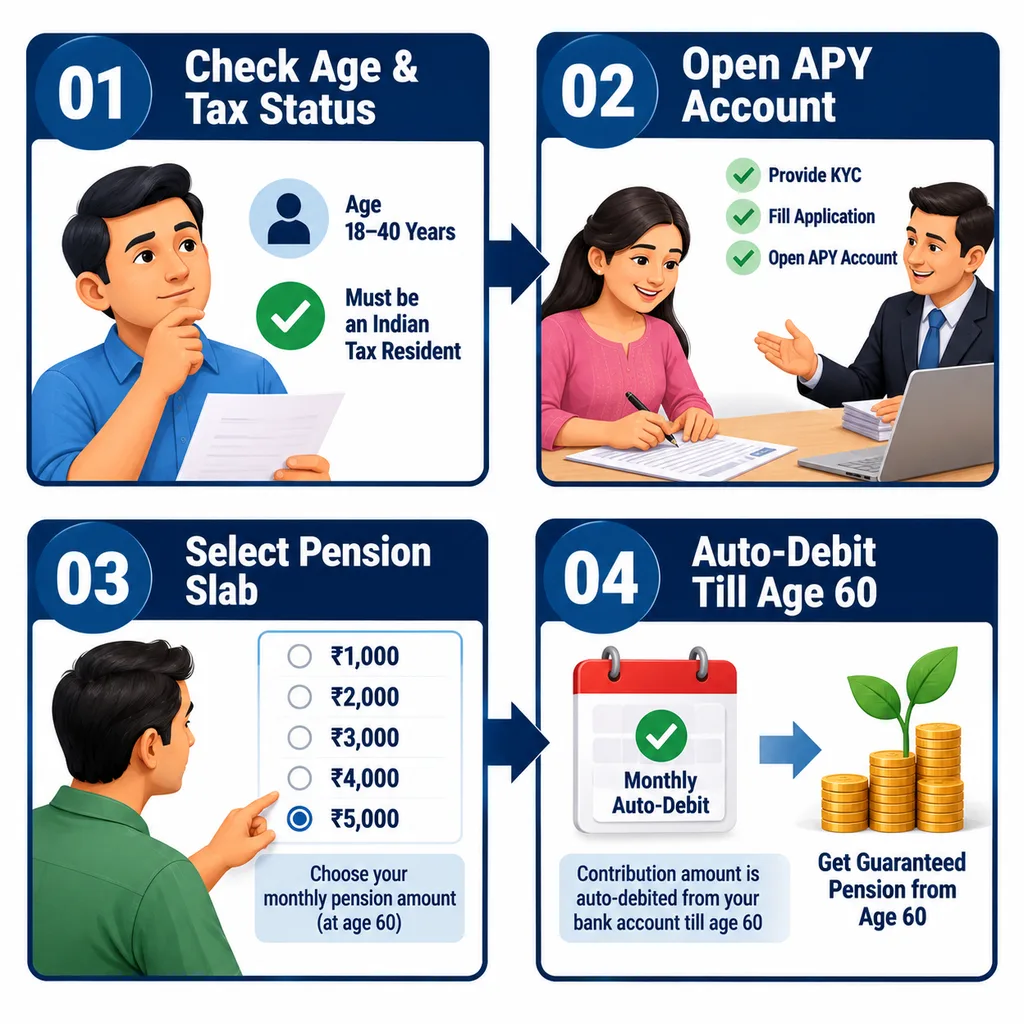
The scheme is open to eligible Indian citizens aged 18 to below 40 years, provided they have a savings bank or Post Office savings bank account. However, a major eligibility restriction applies to new subscribers: from 1 October 2022, an individual who is or has been an income-tax payer on the application date cannot open a new APY account.
APY has also received a significant policy update in 2026. The Union Government approved continuation of the scheme and related promotional/developmental support through 2030–31.
For related financial-scheme updates, readers can visit the Finance & Market section on Desk4Info.

APY 2026 Key Details
| Particular | Current verified information |
|---|---|
| Scheme | Atal Pension Yojana |
| Regulator | PFRDA |
| Eligible age | 18 to below 40 years |
| Pension starts | Age 60 |
| Guaranteed pension | ₹1,000–₹5,000/month |
| Contribution frequency | Monthly / Quarterly / Half-yearly |
| Payment method | Auto-debit from savings account |
| New income-tax payers | Not eligible to open APY from 1 October 2022 |
| Scheme continuation | Approved up to 2030–31 |
Current official information is available through the PFRDA APY information and FAQ pages and the Department of Financial Services APY page.
Eligibility and Taxpayer Rule
APY is available to an Indian citizen who meets the prescribed age and account conditions. A Central or State Government employee, PSU employee or existing NPS subscriber can also join if the basic APY eligibility requirements are satisfied.
The taxpayer restriction requires particular attention. A person who is an income-tax payer on the application date cannot make a new APY subscription from 1 October 2022. This does not mean that an existing APY subscriber automatically becomes ineligible merely because they subsequently become an income-tax payer.
⚠️ Critical Mandatory Warning: Before opening a new APY account, verify your income-tax status on the application date. The post-1 October 2022 taxpayer restriction applies to new subscriptions, not as a blanket cancellation rule for every existing subscriber.
A savings bank account or Post Office savings bank account is mandatory, and nominee details are also required. Aadhaar authentication/proof is part of the APY identification framework, with PFRDA explaining the applicable Aadhaar requirements.
Contribution and Pension Slabs
The contribution is determined by three factors: subscriber’s entry age, selected guaranteed pension and contribution frequency. Contributions can be made monthly, quarterly or half-yearly through auto-debit.
| Entry Age | ₹1,000 Pension | ₹2,000 | ₹3,000 | ₹4,000 | ₹5,000 |
|---|---|---|---|---|---|
| 18 | ₹42 | ₹84 | ₹126 | ₹168 | ₹210 |
| 25 | ₹76 | ₹151 | ₹226 | ₹301 | ₹376 |
| 30 | ₹116 | ₹231 | ₹347 | ₹462 | ₹577 |
| 35 | ₹181 | ₹362 | ₹543 | ₹722 | ₹902 |
| 40 | ₹291 | ₹582 | ₹873 | ₹1,164 | ₹1,454 |
These are official APY contribution-table figures. The lower contribution at younger entry ages reflects the longer contribution period before age 60.
Subscribers can also change their selected pension amount through the prescribed upgrade/downgrade facility. PFRDA’s FAQ specifies the applicable annual window for this change.
Gateway Management: Account, Auto-Debit and Defaults
APY contributions are collected automatically from the subscriber’s linked savings account. The applicable debit cycle depends on whether the subscriber selected monthly, quarterly or half-yearly contribution frequency.
PFRDA issued new APY Operational Guidelines on 27 February 2026, effective from 1 April 2026. The guidelines cover subscriber onboarding, contribution management, grievance redressal, death claims, voluntary exit and other operational services.
The revised framework requires PoP-APY institutions to issue an acknowledgement/receipt with a unique number, preferably electronically, and to communicate subsequent contribution information through SMS, email or another electronic mode.
If a contribution cannot be collected because sufficient balance is unavailable, overdue charges can apply. The operational guidelines state that debit cycles continue until applicable contributions are recovered, subject to the scheme rules.
Pension, Spouse and Nominee Benefits
At age 60, the subscriber receives the selected guaranteed minimum pension—₹1,000, ₹2,000, ₹3,000, ₹4,000 or ₹5,000 per month—for life. After the subscriber’s death, the spouse receives the same pension for their lifetime under the scheme framework.
After both subscriber and spouse die, the nominee receives the pension wealth accumulated under the APY rules. For an unmarried subscriber who dies before 60, the prescribed accumulated corpus is returned to the nominee.
If the subscriber dies before 60, the spouse has an option to continue the APY account for the remaining period until the deceased subscriber would have reached 60, subject to the prescribed conditions.
Exit Before 60 and Important 2025 Update
Voluntary exit before age 60 is permitted under APY. Generally, the subscriber receives their own contributions plus accrued income after applicable account-maintenance charges, subject to the scheme’s exit provisions. Subscribers who had received the old Government co-contribution have separate treatment for that amount on voluntary exit.
A major regulatory development came through the 18 August 2025 Gazette notification. It inserted a provision stating that detailed exit modalities would be specified by PFRDA in consultation with the Government.
Therefore, older articles should not automatically be treated as the final authority for every exit procedure.
Current APY Status in 2026
PFRDA’s live homepage currently reports 7.98 crore active APY accounts and approximately ₹58,531 crore AUM, with the dashboard data dated 20 September 2026. The page specifically identifies these figures as active APY accounts.
Separately, PFRDA reported that APY’s gross enrolments crossed 9 crore on 21 April 2026. These two numbers should not be presented as contradictory: the April figure is gross enrolment, while the September dashboard figure is specifically for active accounts.
The Government has approved APY’s continuation through 2030–31.
Red-Flag Errors Before Joining APY
- Ignoring the income-tax payer restriction for a new account.
- Choosing the pension slab without checking the long-term contribution commitment.
- Allowing insufficient balance on contribution debit dates.
- Not updating nominee/spouse information after marriage or other relevant changes.
- Assuming the ₹5,000 pension is a return on investment: it is the selected guaranteed minimum pension under APY, not an advertised market-return calculation.
- Using outdated exit information without checking the latest PFRDA rules.
- Opening duplicate APY accounts: the 2026 operational guidelines require PoPs to prevent multiple APY accounts for the same subscriber.
APY FAQs
Can an income-tax payer open a new APY account?
A person who is or has been an income-tax payer on the application date cannot open a new APY account from 1 October 2022. An existing APY subscriber who later becomes an income-tax payer is not automatically treated as a new ineligible subscriber.
How much pension does APY provide?
The Government guarantees a minimum monthly pension of ₹1,000 to ₹5,000 from age 60 according to the selected pension slab. The spouse receives the same pension after the subscriber’s death, subject to scheme rules.
Can APY be closed before age 60?
Yes, voluntary exit before 60 is permitted under the applicable rules. The amount payable depends on the contribution, accrued income, applicable charges and the subscriber’s circumstances.
Official Departmental Directory
| Purpose | Official Resource |
|---|---|
| APY Scheme Information | PFRDA APY Scheme / FAQ |
| Government APY Information | Department of Financial Services — APY |
| APY Gazette Notifications | PFRDA APY Gazette Notifications |
| 2026 Operational Guidelines | PFRDA APY Operational Guidelines, 27 Feb 2026 |
| Jan Suraksha APY Information | Jan Suraksha APY portal |
Editorial Integrity Disclaimer
APY is a regulated pension scheme and its operational rules can be amended through Government notifications and PFRDA directions. The information above reflects the official material available through 23 September 2026, including the PFRDA operational guidelines effective from 1 April 2026 and the current PFRDA dashboard dated 20 September 2026.
The old Government co-contribution should not be presented as a current benefit for new subscribers, and the 2025 Gazette amendment means exit procedures should be checked against the latest PFRDA instructions rather than older summaries.
For account opening or a financial decision, readers should verify the latest instructions directly with the PFRDA official website, their APY service provider, or the Department of Financial Services.