





Senior Citizens’ Savings Scheme, commonly called SCSS, remains one of the Government-backed small savings options specifically designed for eligible senior citizens and certain retired individuals. For the current July–September 2026 quarter, the SCSS interest rate is 8.2% per annum, and the National Savings Institute lists the same rate across the 2026–27 quarters currently displayed on its interest-rate table.
The scheme is governed by the Senior Citizens’ Savings Scheme, 2019 and subsequent amendments. The maximum deposit limit is ₹30 lakh, while the minimum deposit is ₹1,000, in multiples as prescribed under the scheme framework. The 2023 amendment specifically increased the earlier ₹15 lakh ceiling to ₹30 lakh.
This is not a pension scheme and it does not provide a government salary. Instead, the depositor places eligible savings into an SCSS account and receives interest on a quarterly basis. Readers looking for other government-backed financial schemes can also explore the Finance & Market section on Desk4Info.

SCSS 2026: Key Scheme Details
| Particular | Verified Details |
|---|---|
| Scheme | Senior Citizens’ Savings Scheme (SCSS) |
| Governing framework | Senior Citizens’ Savings Scheme, 2019 |
| Current interest rate | 8.2% per annum |
| Current period | 1 July 2026 to 30 September 2026 |
| Minimum deposit | ₹1,000 |
| Maximum deposit | ₹30 lakh |
| Interest payment | Quarterly |
| Standard maturity | 5 years |
| Extension | Further 3 years, subject to scheme rules |
| Account type | Individual or joint with spouse |
| Selection process | Not applicable |
| Recruitment deadline | Not applicable |
The Department of Economic Affairs recorded that small-savings rates for Q2 FY 2026–27 remained unchanged from Q1. The National Savings Institute’s current table consequently shows SCSS at 8.2% for April–June and July–September 2026.
Who Can Open an SCSS Account?
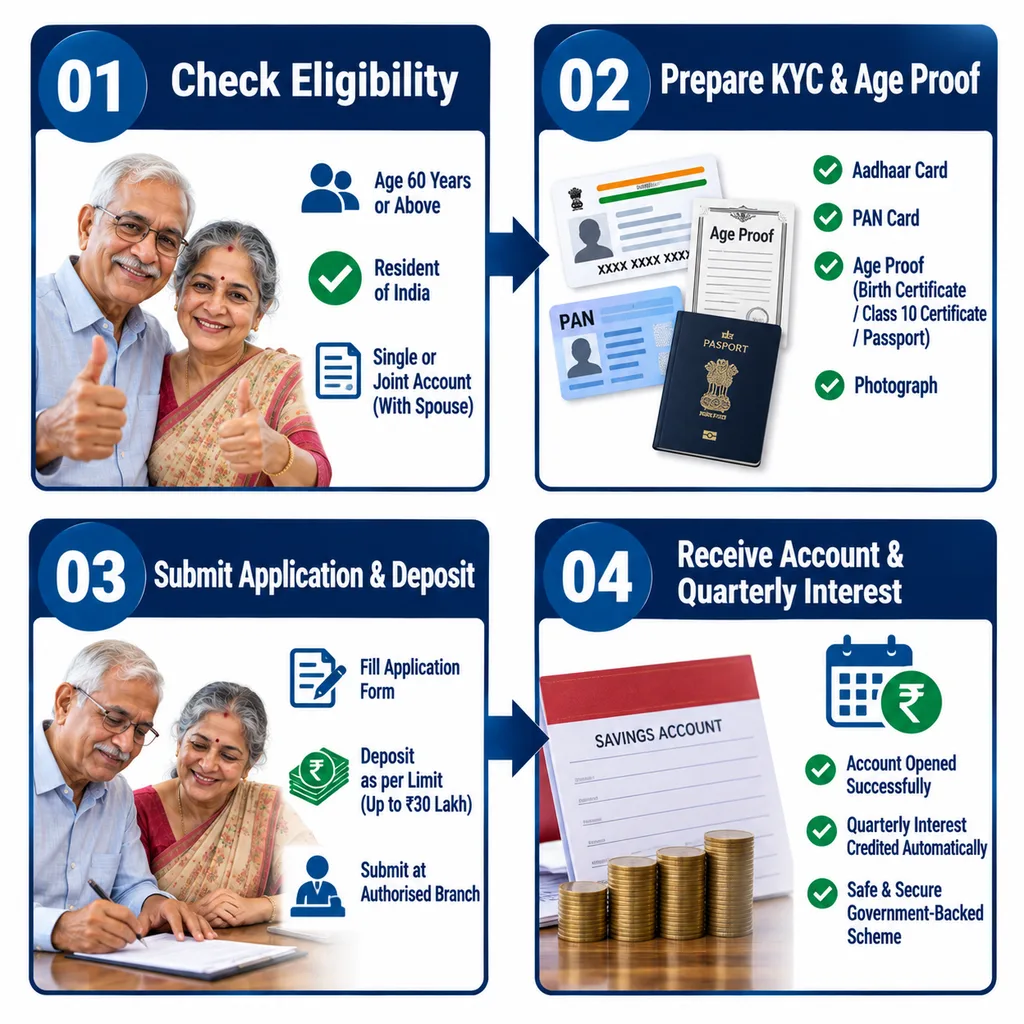
The principal eligibility rule permits an individual who has attained 60 years of age on the date of opening the account to subscribe. The 2019 scheme also provides a route for individuals aged 55 years or more but below 60 years who have retired on superannuation or otherwise, subject to prescribed conditions concerning receipt of retirement benefits and supporting employer documentation.
Retired personnel of Defence Services, excluding civilian defence employees, have a separate eligibility provision from 50 years of age, subject to the applicable conditions. The National Savings Institute also confirms this category in its current SCSS information.
The account may be opened individually or jointly with the spouse. The deposit ceiling applies to the combined deposits permitted under the scheme rather than creating a separate ₹30 lakh entitlement for every account held by the same depositor.
⚠️ Critical Mandatory Warning: SCSS eligibility for the 55–60 age group is not simply based on age. Retirement status, retirement-benefit receipt and prescribed supporting documents must satisfy the scheme conditions before the account is opened.
Deposit, Interest and Maturity Rules
SCSS is structured around a five-year maturity period. The National Savings Institute states that the account may subsequently be extended for another three years under the applicable rules. Interest is payable quarterly, with the scheme specifying the relevant quarter-end dates and subsequent payment schedule.
At the current 8.2% rate, a simple annual-rate illustration on ₹10 lakh would indicate ₹82,000 annual interest before considering tax treatment. Because SCSS interest is paid quarterly, the annual figure corresponds to four quarterly payments rather than monthly income.
For the maximum ₹30 lakh deposit, the simple annual interest at 8.2% works out to ₹2.46 lakh before tax. This is an illustration based on the notified rate; actual payment arrangements and applicable tax deductions should be checked with the account office.
The 2023 amendment is particularly important because it changed the maximum deposit from ₹15 lakh to ₹30 lakh. Therefore, older SCSS articles showing a ₹15 lakh ceiling should not be treated as current 2026 guidance.
Account Opening and Documents
The official Post Office operational material describes SCSS account opening through an application form accompanied by KYC-related documentation, age proof and, where applicable, a joint photograph with the spouse. PAN-related requirements also apply under the prevailing tax and account-opening framework.
A practical checklist should therefore include:
- Age proof.
- Identity and address/KYC documents.
- PAN details or applicable declaration where permitted.
- Retirement-benefit proof for eligible 55–60-year-old retirees.
- Employer certificate where required by the scheme.
- Spouse details and joint-account documentation, if applicable.
- Deposit amount through the permitted payment method.
The exact document list can vary according to the applicant’s category and account office, so applicants should confirm the current checklist before submitting the application.
Tax Treatment: What SCSS Investors Should Check
SCSS interest is not automatically tax-free. It forms part of the investor’s taxable income according to the applicable income-tax provisions.
For AY 2026–27, the Income Tax Department identifies Form 15H as a declaration available to a resident individual aged 60 years or more for eligible receipts without TDS, subject to the statutory conditions. The department also currently explains the Section 80TTB deduction for resident senior citizens, with a maximum deduction of ₹50,000 for eligible interest from specified deposits.
The tax position can differ depending on the taxpayer’s total income, tax regime and other sources of income. Therefore, SCSS should not be described as a “tax-free investment” merely because it is a government-backed small-savings scheme.
For tax-related government updates, readers can also follow the Government Schemes section and the Finance & Market section on Desk4Info.
Premature Closure and Practical Checks
SCSS allows premature closure, but it is subject to prescribed conditions rather than being an unrestricted withdrawal facility. The applicable rules should therefore be checked at the time of closure, particularly because the account’s duration, date of opening and applicable amendments can affect the calculation.
Before depositing a substantial amount, an investor should verify four things: eligibility, current interest rate, liquidity requirement and tax position. The current official rate for July–September 2026 is 8.2%, but small-savings rates are reviewed by the Government periodically, so the rate should always be checked for the relevant quarter rather than copied from an old article.
Candidate FAQs
Is SCSS interest rate 8.2% in 2026?
Yes. The official National Savings Institute table and the Department of Economic Affairs’ 2026 small-savings rate record show 8.2% per annum for SCSS for the July–September 2026 quarter.
What is the maximum SCSS deposit?
The current maximum is ₹30 lakh, following the 2023 amendment that replaced the earlier ₹15 lakh ceiling. The minimum deposit is ₹1,000, subject to the scheme’s prescribed multiples.
Can a person below 60 years open SCSS?
Yes, but only specified categories qualify. The 2019 scheme provides eligibility for certain retired persons aged 55–59 years, while retired Defence Services personnel have a separate provision beginning at 50 years, subject to conditions.
Official Departmental Directory
| Resource | Purpose |
|---|---|
| myScheme SCSS Scheme Page | Scheme discovery and citizen-facing information |
| Department of Economic Affairs — Small Savings | Current small-savings interest-rate notifications |
| National Savings Institute — SCSS | SCSS eligibility, deposit and operational overview |
| SCSS 2019 Scheme Text | Original 2019 scheme framework |
| 2023 SCSS Amendment Notification | ₹15 lakh to ₹30 lakh limit amendment |
| Income Tax Department — Senior Citizens AY 2026–27 | Current tax guidance for senior citizens |
Editorial Integrity Disclaimer
This article has been prepared by combining the user-supplied myScheme and RBI references with current official Government sources, particularly the Department of Economic Affairs, National Savings Institute, India Post and Income Tax Department. The 8.2% rate quoted above specifically reflects the July–September 2026 period and should not be treated as a permanently fixed SCSS rate.
Before opening an account or making a large deposit, readers should verify the latest notification, applicable scheme rules and tax provisions through the relevant official authority. Older SCSS information containing a ₹15 lakh maximum deposit limit is outdated after the 2023 amendment.