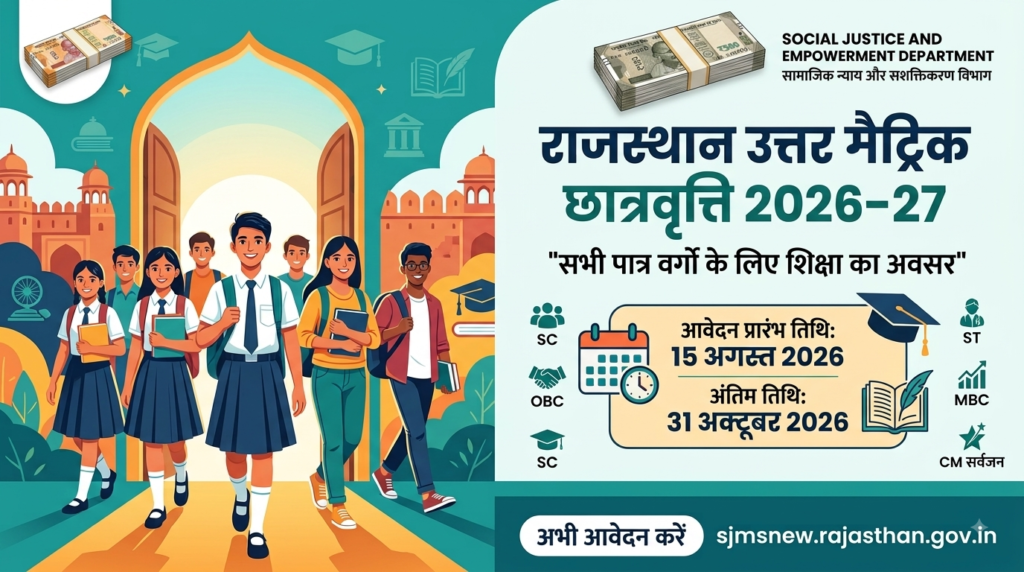










Education is one of the biggest investments a family can make. For many students, however, school fees, college fees, books, hostel expenses, examination costs, transportation, and other educational expenses can become difficult to manage.
Government student schemes can provide support to eligible students through scholarships, fee assistance, educational incentives, skill development, financial support, hostel facilities, and other education-related programmes.
The important part is knowing which student scheme is relevant, who can apply, what documents are required, how to submit the application, and how to check its status.
The Student Schemes section of your website can help students and parents find reliable information about government programmes and educational support in one place.
Students commonly search for student schemes 2026, government schemes for students, student welfare schemes, government schemes for students in India, student scholarship schemes, education schemes 2026, student financial assistance, schemes for college students, schemes after 12th, student schemes online apply, student scheme eligibility, student benefits, and latest government schemes for students.
This guide explains the major types of student schemes and the complete process students should follow before applying.
What Are Student Schemes?
Student schemes are government programmes or educational support initiatives designed for eligible students.
Depending on the programme, support may be related to:
- Scholarships
- Fee assistance
- Educational incentives
- Hostel facilities
- Skill development
- Higher education
- Professional education
- Research
- Digital education
- Examination support
- Educational infrastructure
- Other student welfare activities
The exact benefit depends on the particular scheme.
A student should always check the official eligibility criteria rather than assuming that every student qualifies.
Why Student Schemes Are Important
Financial difficulties can affect a student’s ability to continue education.
Student-focused government programmes may help eligible students reduce certain educational expenses and access opportunities that might otherwise be difficult to afford.
Support may be particularly useful for students from:
- Economically weaker families
- Rural areas
- Specific categories
- Minority communities, where applicable
- Families with limited income
- Certain educational backgrounds
- Other defined beneficiary groups
However, eligibility and benefits differ from one programme to another.
Major Types of Student Schemes
Student schemes can be organized into several broad categories.
1. Scholarship Schemes
Scholarships may provide financial assistance to eligible students based on:
- Merit
- Family income
- Category
- Course
- Academic level
- Other criteria
2. Fee Assistance Schemes
Some programmes may provide assistance toward specified educational fees.
The amount and type of fee covered depend on the applicable scheme.
3. Educational Incentive Schemes
Certain programmes may provide incentives to encourage students to continue or complete education.
These may target particular classes, courses, categories, or educational milestones.
4. Hostel and Residential Support
Some student programmes may provide assistance related to hostel or residential educational facilities for eligible students.
5. Skill Development Schemes
Students may also benefit from government-supported skill development programmes designed to improve employability and vocational skills.
6. Higher Education Schemes
Some programmes support students pursuing higher or professional education.
These may cover areas such as:
- Undergraduate education
- Postgraduate education
- Technical education
- Professional courses
- Research
- Skill-based education
Student Schemes 2026: What Should Students Check?
Government programmes can be updated from time to time.
Before applying, students should verify:
Scheme Name → Eligibility → Course → Institution → Benefits → Documents → Application Deadline → Verification → Status
This simple checklist can prevent many common application mistakes.
Government Schemes for School Students
School students may find schemes covering different stages of education.
Possible areas include:
- Primary education
- Secondary education
- Higher secondary education
- Scholarships
- Educational incentives
- Special educational support
Eligibility may depend on class, academic performance, income, residence, category, or other conditions.
Parents should read the current scheme guidelines before submitting an application on behalf of a child.
Government Schemes After Class 10
Class 10 is an important stage because students begin making decisions about their future educational path.
Depending on eligibility, students may find support related to:
- Higher secondary education
- Scholarships
- Vocational education
- Skill development
- Professional preparation
- Other educational programmes
Students should check whether a particular scheme applies to their class, course, institution, and academic year.
Government Schemes After Class 12
After Class 12, students enter a wide range of educational programmes.
Student schemes may be available for eligible students pursuing:
- Bachelor’s degrees
- Engineering
- Medical education
- Law
- Management
- Commerce
- Arts
- Science
- Pharmacy
- Nursing
- Agriculture
- Other professional courses
Not every scholarship or student scheme covers every course.
Schemes for College Students
College students can explore programmes based on:
- Academic merit
- Family income
- Course
- Category
- Disability
- State
- Institution
- Other conditions
Students should check whether the scheme applies to their current year of study.
A scheme available to first-year students may not necessarily have the same eligibility for students in later years.
Schemes for Professional Course Students
Professional education can involve significant expenses.
Depending on the programme, eligible students may find educational support for fields such as:
- Medicine
- Engineering
- Law
- Pharmacy
- Nursing
- Architecture
- Management
- Agriculture
- Other professional education
Students should verify whether their specific course and institution are recognized under the scheme.
Student Schemes for Higher Education
Higher education schemes may support eligible students pursuing advanced academic or professional studies.
Depending on the programme, support may relate to:
- Tuition
- Maintenance
- Research
- Educational materials
- Accommodation
- Other approved expenses
Students should carefully read the benefit structure because a scheme’s total benefit may not mean that every expense is fully covered.
Student Schemes for Economically Weaker Families
Some student programmes are designed to support students who meet specified financial criteria.
Such schemes may require an income certificate or other evidence of financial eligibility.
Before applying, check:
- Annual family income limit
- Income certificate format
- Issuing authority
- Validity period
- Other financial conditions
An outdated or incorrect income certificate may create problems during verification.
Student Schemes for Girls
Government programmes may also encourage girls to continue education.
Depending on the programme, support can be associated with:
- School education
- Higher education
- Scholarships
- Skill development
- Professional education
Eligibility varies considerably between schemes.
A student should verify whether the programme applies to her class, course, state, income category, and institution.
Student Schemes for Students With Disabilities
Eligible students with disabilities may have access to educational assistance under applicable programmes.
Requirements may include:
- Valid disability certificate
- Academic qualification
- Institution details
- Income criteria
- Course details
- Other programme-specific conditions
Students should use the prescribed certification and application process.
Student Schemes for Minority Communities
Some government programmes may be designed for eligible students belonging to specified communities.
The applicable conditions can include:
- Community/category
- Family income
- Academic performance
- Course
- Institution
- Admission status
Students should verify the current official guidelines before applying because programme names, eligibility, and implementation can change.
Student Skill Development Schemes
Education and employment are closely connected.
Government-supported skill programmes may help students develop practical abilities in areas such as:
- Computer skills
- Digital skills
- Technical skills
- Vocational training
- Industry-related skills
- Entrepreneurship
- Other job-oriented areas
Students should distinguish between a skill training opportunity and a guaranteed employment opportunity.
Completing a course does not automatically guarantee a job unless the official programme specifically provides such an arrangement.
Documents Commonly Required
The document list varies by scheme.
Common documents may include:
- Aadhaar or accepted identity proof
- Passport-size photograph
- Mobile number
- Bank account details
- Previous marksheet
- Current admission proof
- Fee receipt
- Income certificate
- Caste/category certificate, where applicable
- Domicile/residence certificate, where applicable
- Disability certificate, where applicable
- Institution details
- Course details
- Other scheme-specific documents
Students should submit only the documents required by the official application process.
How to Apply for Student Schemes Online
Where an online application is available, students can generally follow these steps.
Step 1: Find the Official Scheme
Start with the official government department, education department, scholarship portal, university, or authorized agency.
Step 2: Read Eligibility
Check every condition before registering.
Step 3: Register
Create an account using the required information.
Step 4: Complete the Application
Enter personal, academic, family, and institution details carefully.
Step 5: Upload Documents
Upload the required documents in the specified format.
Step 6: Review the Form
Check names, dates, marks, bank details, course, and institution information.
Step 7: Submit
Submit the application before the deadline.
Step 8: Save the Acknowledgement
Keep the application number or receipt for future reference.
Common Mistakes in Student Scheme Applications
Students should be especially careful about basic details.
Common mistakes include:
- Incorrect name
- Wrong date of birth
- Incorrect marks
- Wrong course
- Incorrect college name
- Wrong bank account number
- Incorrect IFSC information
- Invalid income certificate
- Missing documents
- Uploading unclear documents
- Selecting the wrong category
- Missing the application deadline
Review the application carefully before final submission.
Student Scheme Verification Process
Submitting an application does not necessarily mean that the benefit has been approved.
Depending on the programme, the application may pass through several stages:
Student Application → Institution Verification → Department Verification → Final Approval → Payment/Benefit
The actual process differs between schemes.
Students should regularly check the official application status.
How to Check Student Scheme Status
If an online tracking facility is available, students may need:
- Application number
- Registration ID
- Student ID
- Date of birth
- Mobile number
- Other prescribed information
Possible statuses may include:
- Submitted
- Pending
- Under verification
- Verified
- Defective
- Rejected
- Approved
- Payment processed
- Payment pending
The terminology varies between portals.
What Does a Defective Student Application Mean?
A defective application generally means that some information or document requires correction.
Students should:
- Open the official application status.
- Read the reason for the defect.
- Correct the required information.
- Upload a replacement document if requested.
- Resubmit within the permitted period.
Do not ignore a defect notification because failure to correct it may affect further processing.
Why Can a Student Scheme Application Be Rejected?
Possible reasons include:
- Eligibility not satisfied
- Incorrect information
- Family income above the prescribed limit
- Course not covered
- Institution not eligible
- Incorrect documents
- Verification failure
- Duplicate application
- Bank details mismatch
- Missing mandatory information
- Application submitted after the deadline
The exact reason should be checked through the official portal or communication from the concerned authority.
Student Scheme Renewal
Some student schemes are renewable.
A student may need to submit a renewal application for the next academic year.
Renewal can depend on:
- Successful completion of the previous year
- Minimum marks
- Attendance
- Continued admission
- Income criteria
- Other scheme conditions
Students should not assume that a scholarship or benefit automatically continues every year.
Student Scheme Payment
Where a scheme provides financial assistance, payment may be made through the prescribed government or institutional payment system.
Students should ensure that:
- Bank information is correct
- Required verification is complete
- Application is approved
- No correction is pending
- Required identity verification is completed
Approval and payment are not always simultaneous.
Why Student Scheme Payments Can Be Delayed
Possible reasons include:
- Pending verification
- Incorrect bank details
- Application correction
- Institutional verification
- Administrative processing
- Payment processing
- Technical issues
- Other scheme-specific reasons
Students should first check the official status before assuming that the benefit has been cancelled.
Student Scheme vs Scholarship
A scholarship is one type of student support.
A student scheme is a broader term that can include:
- Scholarships
- Fee assistance
- Skill development
- Hostel support
- Educational incentives
- Other student welfare programmes
Therefore, not every student scheme is a scholarship.
Student Scheme vs Education Loan
Students should also understand the difference between government educational assistance and loans.
| Student Scheme / Scholarship | Education Loan |
|---|---|
| May provide financial assistance subject to eligibility | Borrowed funds |
| Usually governed by scheme rules | Governed by lender terms |
| May not require repayment in the same way as a loan | Generally requires repayment |
| Selection depends on eligibility and verification | Approval depends on lending criteria |
Students should carefully understand the terms before making financial decisions.
How Parents Can Help Students
Parents can help by:
- Checking eligibility
- Preparing documents
- Obtaining valid certificates
- Reviewing application details
- Monitoring deadlines
- Checking application status
- Helping identify suspicious messages
Parents should also teach students not to share confidential banking information with unknown persons.
Beware of Fake Student Scheme Websites
Students are often targeted by fake scholarship and government scheme websites.
Be careful if a website or person claims:
- “Guaranteed government scholarship”
- “Every student will receive money”
- “Pay a fee to activate your benefit”
- “Send OTP for verification”
- “Share UPI PIN to receive payment”
- “Instant approval guaranteed”
Always verify the programme through the official government department, education institution, or authorized provider.
How to Find the Right Student Scheme
A practical search method is:
Step 1: Identify Your Education Level
School, Class 10, Class 12, undergraduate, postgraduate, professional course, or research.
Step 2: Identify Your Course
Check whether the scheme covers your specific course.
Step 3: Check Academic Performance
Look for minimum marks or merit requirements.
Step 4: Check Family Income
Verify the applicable income limit.
Step 5: Check State and Institution
Some programmes may have state or institution restrictions.
Step 6: Check Category-Specific Conditions
Where applicable, review category, disability, or other conditions.
Step 7: Check the Deadline
Never leave the application until the last day if avoidable.
How to Organize Student Scheme Content on Your Website
Your Student Schemes category can be organized into useful subtopics such as:
- School Student Schemes
- College Student Schemes
- Higher Education Schemes
- Scholarship Schemes
- Girls’ Education Schemes
- Skill Development Schemes
- Professional Course Schemes
- Student Financial Assistance
- State Student Schemes
- Central Student Schemes
This structure makes it easier for visitors to find information relevant to their education level.
Recommended Format for Every Student Scheme Post
For each individual scheme, use a consistent structure:
- Scheme Name
- Overview
- Objective
- Who Can Apply
- Eligibility
- Academic Requirements
- Income Criteria
- Course Eligibility
- Benefits
- Documents Required
- Application Process
- Online Application
- Verification Process
- Renewal Process
- Payment Details
- Status Check
- Important Dates
- Latest Updates
- FAQs
- Official Source
- Last Updated Date
- Disclaimer
This format can answer most questions students search for before applying.
SEO Keywords for Student Schemes
Useful search terms include:
- Student schemes 2026
- Government schemes for students
- Student welfare schemes
- Government student schemes in India
- Education schemes 2026
- Student scholarship schemes
- Student financial assistance
- Student schemes online apply
- Student scheme eligibility
- Government schemes after 12th
- Government schemes for college students
- Government schemes for school students
- Government schemes for girls
- Government schemes for higher education
- Student benefits
- Latest student schemes
- New student schemes 2026
- Student scholarship application
- Student scheme status check
- Education government schemes
- Student scheme documents
Use these terms naturally and only where they accurately describe the content.
Frequently Asked Questions
What are student schemes?
Student schemes are government or authorized educational programmes designed to provide eligible students with scholarships, financial assistance, educational incentives, skill development, or other forms of support.
Who can apply for student schemes?
Eligibility varies by programme. Academic performance, income, course, institution, age, state, category, and other conditions may apply.
Are student schemes available for school students?
Yes, some programmes are specifically designed for school-level students, subject to eligibility.
Are there government schemes for students after Class 12?
Yes, eligible students may find schemes and scholarships for higher education, professional courses, skill development, and other educational opportunities.
Can college students apply for government schemes?
Yes, depending on the eligibility criteria of the particular programme.
What documents are generally required?
Identity proof, academic records, income certificate, bank details, admission proof, and other scheme-specific documents may be required.
Can I apply for multiple student schemes?
This depends on the rules of the individual programmes. Some schemes may have restrictions on receiving multiple benefits.
What does student scheme renewal mean?
Renewal generally means applying to continue an eligible benefit for another academic year, subject to the applicable conditions.
Why is my student scheme application pending?
It may be awaiting institutional verification, departmental verification, document review, payment processing, or another administrative step.
What does “defective application” mean?
It generally means that some information or document requires correction before the application can continue processing.
How can I check my student scheme status?
Use the official application portal or tracking system provided by the concerned authority.
Are student schemes guaranteed?
No. Benefits are subject to eligibility, verification, applicable rules, and the decision of the concerned authority.
Final Takeaway
Student schemes can make education more accessible by providing scholarships, financial assistance, educational incentives, skill development, fee support, and other benefits to eligible students.
But students should never apply based only on a social media post, forwarded message, or attractive headline.
Follow this process:
Identify Your Education Level → Find the Relevant Scheme → Check Eligibility → Verify the Official Source → Prepare Documents → Apply Carefully → Complete Verification → Track Status → Renew When Required
For your website, the Student Schemes category should focus on practical, accurate, and regularly updated information.
Each article should clearly answer the questions students actually ask:
Who is eligible? How much support is available? What documents are required? How do I apply? What is the last date? How can I check my status? What should I do if my application is defective or rejected?
Avoid misleading claims such as “Every Student Will Get ₹50,000” or “100% Scholarship Guaranteed” unless such statements are directly supported by the official rules.
The purpose of high-quality student-scheme content should be simple: help students discover genuine opportunities, understand eligibility, complete applications correctly, and avoid scams.
The best student information is not the information with the biggest promise—it is the information that helps a student make the right decision with confidence.
Informational Disclaimer
This article is provided for general informational and educational purposes only. It is not an official government notification, scholarship approval, educational grant, financial guarantee, or assurance of any benefit.
Student schemes, eligibility criteria, scholarship amounts, application procedures, deadlines, documents, verification requirements, and payment rules may change from time to time.
Students and parents should verify the latest information through the official website of the concerned government department, education department, scholarship authority, university, institution, or authorized agency before applying.
Approval and payment of any benefit are subject to the applicable rules, verification process, availability of the programme, and decision of the competent authority.
This website does not guarantee scholarship selection, financial assistance, fee reimbursement, admission, employment, skill-training placement, or any other student benefit.
Students should never share OTPs, UPI PINs, ATM PINs, passwords, or other confidential banking credentials with unknown persons claiming to process student schemes or scholarship applications.
This disclaimer does not exclude or limit any liability that cannot lawfully be excluded or limited under applicable law.