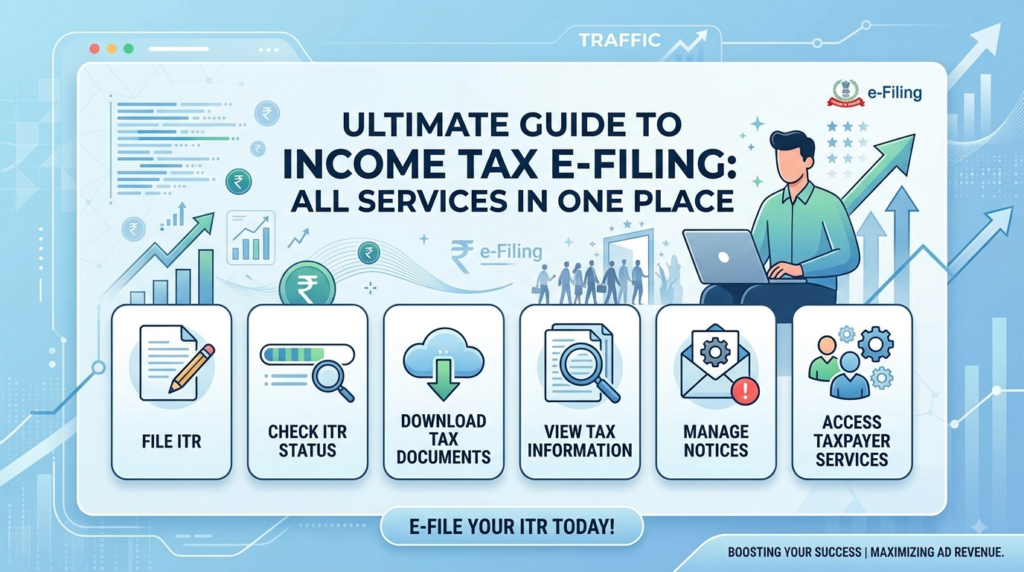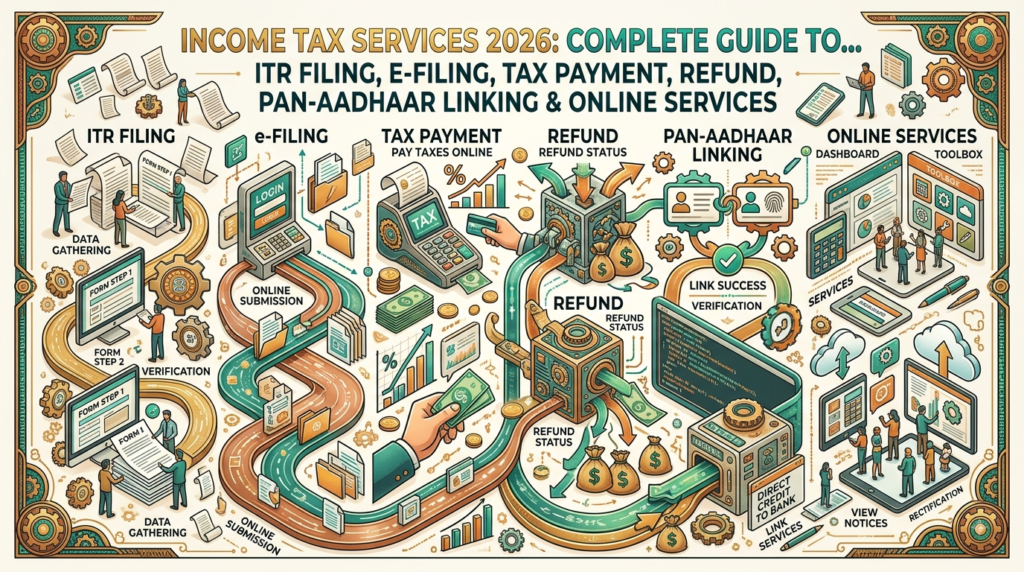









Income tax becomes much easier when you understand what is taxable, which return you need to file, what deductions may be available, and how your tax is actually calculated. Many taxpayers, however, wait until the last date to think about taxes and then struggle with Form 16, TDS, AIS, Form 26AS, capital gains and ITR filing.
Whether you are a salaried employee, business owner, freelancer, investor, pensioner, student with taxable income or a person earning from multiple sources, understanding the basics of income tax in India can help you avoid common mistakes.
This guide covers income tax, income tax slabs, old vs new tax regime, ITR filing, TDS, Form 16, Form 26AS, AIS, tax deductions, capital gains, tax refunds, advance tax, tax planning and common income tax mistakes.
Important: Tax laws, tax rates, deductions, exemptions, filing procedures and deadlines can change. The information below is educational and should not be treated as individual tax advice. Always verify the latest provisions on the official Income Tax Department portal before filing a return or making a tax decision.
What Is Income Tax?
Income tax is a tax imposed on taxable income according to the applicable provisions of Indian tax law.
Individuals may have income from different sources, such as:
- Salary
- Business
- Profession
- House property
- Bank interest
- Dividends
- Capital gains
- Pension
- Freelancing
- Rental income
- Other taxable sources
Your total tax liability depends on the nature and amount of income, applicable deductions and exemptions, the tax regime selected where applicable, and other provisions of law.
Why Understanding Income Tax Matters
Income tax is not only about paying tax.
Good tax management also means:
- Filing the correct ITR
- Reporting income accurately
- Checking TDS
- Claiming eligible deductions
- Tracking investments
- Keeping supporting documents
- Checking tax notices
- Claiming eligible refunds
- Meeting applicable deadlines
A small mistake in reporting income can create problems later.
Financial Year vs Assessment Year
This is one of the first concepts every taxpayer should understand.
Financial Year (FY)
The financial year is the period in which income is earned.
For example:
FY 2025-26 = 1 April 2025 to 31 March 2026
Assessment Year (AY)
The assessment year is the year in which the income of the previous financial year is assessed and the relevant income-tax return is filed.
Therefore:
FY 2025-26 → AY 2026-27
This distinction is particularly important when searching for ITR forms, tax slabs and filing instructions.
Income Tax Slabs in India
For AY 2026-27, the Income Tax Department lists the new tax regime as the default regime for eligible individual taxpayers, while eligible taxpayers can opt for the old tax regime subject to applicable rules. (Income Tax Department)
For individuals under the new regime, the listed slabs for AY 2026-27 are:
| Taxable Income | New Tax Regime Rate |
|---|---|
| Up to ₹4 lakh | Nil |
| ₹4 lakh–₹8 lakh | 5% |
| ₹8 lakh–₹12 lakh | 10% |
| ₹12 lakh–₹16 lakh | 15% |
| ₹16 lakh–₹20 lakh | 20% |
| ₹20 lakh–₹24 lakh | 25% |
| Above ₹24 lakh | 30% |
These are slab rates, so the applicable rate is not simply applied to the entire income at the highest slab reached. (Income Tax Department)
The Income Tax Department also states that the Section 87A rebate under the new regime has been increased to ₹60,000 for eligible taxpayers with total income up to ₹12 lakh from AY 2026-27, subject to the applicable conditions. (Income Tax Department)
Always verify the latest tax provisions before filing, especially because tax rules can change through Finance Acts and notifications.
Old Tax Regime vs New Tax Regime
This is one of the most searched income-tax questions in India:
Which is better — old tax regime or new tax regime?
There is no universal answer.
Old Tax Regime
The old regime generally provides access to various deductions and exemptions, subject to eligibility and conditions.
Depending on the taxpayer, these may include deductions relating to areas such as:
- Certain investments
- Eligible health insurance
- Certain housing-loan interest
- Certain education-loan interest
- Other provisions under the Income Tax Act
New Tax Regime
The new regime generally has different slab rates and fewer deductions/exemptions than the old regime.
For AY 2026-27, the new regime is the default for eligible taxpayers, while eligible taxpayers can choose to opt out under the applicable rules. (Income Tax Department)
How to Choose Between Old and New Tax Regime
Do not choose a tax regime simply because someone says:
“New regime is always better.”
or
“Old regime is always better.”
The better option depends on your individual situation.
Compare:
- Gross income
- Salary structure
- HRA, where applicable
- Home-loan interest
- Eligible deductions
- Insurance premiums
- Investments
- Other taxable income
- Applicable rebates
- Taxable income under each regime
Then compare the final tax liability.
What Is ITR?
ITR means Income Tax Return.
An ITR is a return filed with the Income Tax Department containing information about income, deductions, taxes paid and other relevant details.
Different ITR forms apply to different taxpayers and income situations.
Choosing the correct ITR form is important.
Why Should You File an ITR?
Depending on your circumstances and applicable law, filing an ITR may be required.
Even when filing may not be mandatory in a particular situation, taxpayers sometimes file returns for legitimate purposes such as:
- Claiming eligible tax refunds
- Maintaining income records
- Loan applications
- Visa applications
- Financial documentation
- Carrying forward eligible losses
- Other legitimate financial requirements
The exact filing requirement depends on the applicable provisions.
Common ITR Forms
The Income Tax Department provides different return forms for different taxpayers.
Some commonly encountered forms include:
ITR-1
Generally used by eligible resident individuals meeting the conditions prescribed for the form.
ITR-2
Generally applicable to certain individuals and HUFs who do not have income from business or profession but have specified types of income.
For AY 2026-27, the Income Tax Department states, among other things, that ITR-2 can apply to individuals/HUFs with income from sources such as capital gains and certain other situations, while business/professional income generally requires a different form. (Income Tax Department)
ITR-3
Generally relevant to individuals and HUFs having income from business or profession.
ITR-4
Available to eligible taxpayers under the applicable presumptive taxation provisions and other conditions.
Do not select an ITR form only based on your salary amount. Your complete income profile matters.
What Is TDS?
TDS means Tax Deducted at Source.
In certain transactions, the person making a payment is required to deduct tax at source according to the applicable provisions.
TDS may apply to certain types of:
- Salary
- Interest
- Rent
- Professional payments
- Commission
- Other specified payments
The amount deducted is generally credited against the taxpayer’s tax liability, subject to the applicable rules.
What Is Form 16?
Form 16 is a tax certificate generally issued by an employer to an employee when tax has been deducted from salary, subject to applicable conditions.
It can contain important information such as:
- Salary details
- TDS
- Employer details
- Tax-related information
Salaried employees should carefully check Form 16 before filing their ITR.
What Is Form 26AS?
Form 26AS is a tax-related statement available through the Income Tax Department’s systems.
It can contain information relating to:
- TDS
- TCS
- Certain tax payments
- Other specified tax-related information
Taxpayers should review their available tax records before filing an ITR.
What Is AIS?
AIS stands for Annual Information Statement.
AIS provides taxpayers with broader information relating to financial transactions and tax-related data reported to the Income Tax Department.
It can include information related to transactions such as:
- Interest
- Dividends
- Securities transactions
- Certain financial transactions
- TDS/TCS information
- Other reported information
AIS should be treated as an important cross-checking tool.
Form 26AS vs AIS
These are often confused.
| Form 26AS | AIS |
|---|---|
| Tax-related statement | Broader information statement |
| Includes specified tax credits and related information | Can include wider financial and tax-related information |
| Useful for checking TDS/TCS and tax payments | Useful for cross-checking reported financial information |
Before filing your ITR, compare your income records with the information available in these statements.
How to File an Income Tax Return Online
The general online process includes:
Step 1: Keep Your Documents Ready
Depending on your income, you may need:
- PAN
- Aadhaar, where applicable
- Bank details
- Form 16
- Interest certificates
- Capital-gain statements
- Investment records
- Rental-income information
- Deduction documents
- Other relevant records
Step 2: Review AIS and Form 26AS
Check whether reported information broadly matches your records.
Step 3: Select the Correct ITR
Choose the return form based on your income sources and applicable conditions.
Step 4: Review Pre-Filled Information
Do not blindly accept pre-filled data.
Check it carefully.
Step 5: Report Income
Enter income from all applicable sources.
Step 6: Claim Eligible Deductions
Claim only deductions for which you meet the legal requirements.
Step 7: Calculate Tax
Review the final tax calculation.
Step 8: Pay Additional Tax if Required
If additional tax is payable, complete the applicable payment process.
Step 9: Submit the Return
Review the return before submitting.
Step 10: Verify the ITR
Complete the applicable verification process within the prescribed time.
Important: Do Not Depend Only on Form 16
A common mistake among salaried employees is assuming:
“My Form 16 has everything, so I only need to upload it.”
That may not be sufficient.
You could have additional income from:
- Savings-account interest
- Fixed deposits
- Shares
- Mutual funds
- Rental property
- Freelancing
- Other sources
Your ITR should reflect your applicable income, not merely the information in Form 16.
Income from Salary
Salary income may include more than basic salary.
Depending on the employment structure, it can include:
- Basic salary
- Allowances
- Bonuses
- Perquisites
- Certain reimbursements
- Other taxable components
The actual tax treatment depends on the applicable provisions and nature of the payment.
Income from House Property
Rental income and income relating to house property are governed by specific tax provisions.
Tax calculation may consider:
- Gross rent
- Municipal taxes, where applicable
- Statutory deductions
- Housing-loan interest, where eligible
- Other applicable provisions
Do not calculate house-property tax simply by adding all rent received to salary.
Income from Other Sources
Some income may fall under the category commonly known as Income from Other Sources.
Examples can include:
- Certain interest income
- Certain dividend income
- Certain other taxable receipts
The exact treatment depends on the nature of the income and applicable provisions.
Capital Gains Tax
Capital gains can arise when certain capital assets are transferred for a gain.
Examples may include:
- Shares
- Mutual funds
- Property
- Other capital assets
Capital-gain taxation depends on the type of asset, acquisition date, transfer date and applicable law.
Because capital-gain rules can change, investors should verify the rules applicable to the relevant financial year.
Stock Market and Income Tax
If you invest in shares, simply tracking your buying and selling price may not be enough.
You may need records showing:
- Purchase date
- Purchase price
- Sale date
- Sale value
- Brokerage and eligible costs
- Corporate actions
- Capital-gain statement
Different transactions can have different tax treatment.
Therefore, maintain proper investment records throughout the year rather than trying to reconstruct everything at ITR filing time.
Mutual Funds and Tax
Mutual-fund taxation depends on the type of fund, nature of income and applicable tax rules.
Investors should maintain:
- Purchase records
- Redemption records
- Statements
- Capital-gain reports
- Dividend information, where applicable
Do not assume that all mutual funds have identical tax treatment.
Tax on Interest Income
Interest may be earned from:
- Savings accounts
- Fixed deposits
- Recurring deposits
- Bonds
- Other financial products
Tax treatment varies depending on the nature of the income and applicable provisions.
One of the common mistakes is ignoring small amounts of bank interest.
Even if the amount is small, check whether it needs to be reported.
What Is a Tax Refund?
A tax refund can arise when the tax already paid or deducted is higher than the final tax liability determined under the applicable provisions.
For example, if eligible TDS exceeds your final tax liability, you may become eligible for a refund after processing, subject to the applicable rules.
A refund is not free money.
It generally represents excess tax paid or collected relative to the final tax liability.
What Is Advance Tax?
Advance tax refers to paying tax during the financial year rather than paying the entire amount later, when the applicable conditions are met.
It can be relevant to people with income such as:
- Business income
- Professional income
- Investment income
- Interest
- Other taxable income
Advance-tax requirements depend on the taxpayer’s circumstances and applicable law.
What Is Self-Assessment Tax?
If tax remains payable after considering TDS, TCS, advance tax and eligible credits, the taxpayer may need to pay the applicable balance before filing the return.
This is commonly referred to as self-assessment tax.
Always verify the exact amount before making payment.
Tax Deduction vs Tax Exemption
These terms are often used interchangeably, but they are not exactly the same.
Tax Exemption
Certain income or components may be excluded from taxable income subject to specific conditions.
Tax Deduction
A permitted amount may be deducted while calculating taxable income under the applicable provisions.
Understanding this distinction can make tax planning easier.
Tax Planning vs Tax Evasion
This distinction is extremely important.
Tax Planning
Using legitimate provisions of law to organise finances and claim eligible deductions/exemptions.
Tax Evasion
Hiding income, providing false information or using unlawful methods to avoid tax.
Tax planning is legal when properly done.
Tax evasion can result in serious consequences.
Common Income Tax Mistakes
1. Not Reporting Additional Income
Salary is not necessarily your only taxable income.
2. Choosing the Wrong ITR
Your income sources determine the appropriate return form.
3. Ignoring AIS
Always review available information before filing.
4. Claiming an Ineligible Deduction
Only claim deductions supported by applicable law and genuine documentation.
5. Ignoring Interest Income
Bank and deposit interest should not automatically be overlooked.
6. Forgetting Capital Gains
Share and mutual-fund transactions may have tax implications.
7. Not Verifying the ITR
Submitting the return is not necessarily the final step.
Complete the applicable verification process.
8. Waiting Until the Last Day
Technical issues and missing documents can create unnecessary stress.
9. Entering Incorrect Bank Details
Incorrect details can cause problems with refunds or other processes.
10. Following Random Social-Media Tax Advice
Tax rules are complex and can change.
Use official sources for important tax decisions.
Income Tax Planning for Salaried Employees
Salaried employees can create a simple yearly tax checklist.
At the beginning of the year:
Review:
- Salary structure
- Expected income
- Tax regime
- Eligible investments
- Insurance
- Home-loan details
During the year:
Maintain:
- Investment proofs
- Interest statements
- Bank records
- Capital-gain statements
- Other income records
Before filing:
Check:
- Form 16
- AIS
- Form 26AS
- Bank interest
- Capital gains
- Deductions
- Tax payments
This can make ITR filing significantly easier.
Income Tax Planning for Freelancers
Freelancers should maintain stronger financial records because income may come from multiple clients.
Keep:
- Invoices
- Bank statements
- Client payments
- Eligible business expenses
- TDS certificates
- GST records, where applicable
- Accounting records
Business/professional income can involve additional tax and compliance requirements, so complex cases may require professional assistance.
Income Tax for Senior Citizens
Senior citizens may have income from:
- Pension
- Bank deposits
- Investments
- Rent
- Other sources
Tax treatment depends on the applicable age category, income, regime and current provisions.
Do not rely on old tax rules found in outdated articles.
Tax Planning for Investors
Investors should maintain a tax file containing:
- Demat statements
- Mutual-fund statements
- Capital-gain reports
- Dividend records
- Bank interest
- Tax deductions
- TDS details
Good record keeping can prevent last-minute confusion.
How to Reduce Tax Legally
The correct approach is not:
“How can I hide my income?”
It is:
“Which legal provisions apply to me?”
Depending on the applicable tax regime and your circumstances, legal tax planning may involve:
- Eligible deductions
- Eligible exemptions
- Appropriate investment planning
- Retirement planning
- Insurance planning
- Timing and structuring of legitimate financial transactions
Always verify the current law before taking action.
Is Tax Planning the Same as Investing?
No.
An investment should primarily be evaluated based on:
- Financial objective
- Risk
- Return potential
- Liquidity
- Time horizon
Tax benefit is only one factor.
Never purchase an unsuitable financial product simply because someone says:
“It will save you tax.”
How to Keep Your Tax Records Organised
Create a digital tax folder for each financial year.
For example:
FY 2025-26 Tax Documents
Inside it, maintain:
- Form 16
- Form 26AS
- AIS
- Bank statements
- Interest certificates
- Investment statements
- Capital-gain statements
- Insurance documents
- Eligible deduction documents
- Previous ITR acknowledgement
- Tax payment receipts
This simple habit can save significant time during ITR filing.
Income Tax and Digital Payments
Digital transactions create financial records that may be reported through different information systems.
This does not mean every transaction is automatically taxable.
However, taxpayers should maintain proper records and be able to explain significant transactions when required.
Do not assume:
“If no TDS was deducted, there is no tax.”
Tax liability and TDS are different concepts.
What If You Receive an Income Tax Notice?
Do not panic.
First:
- Read the notice carefully.
- Check the assessment year.
- Check the section mentioned.
- Understand what information is requested.
- Compare it with your ITR and records.
- Respond through the prescribed official channel.
- Seek professional assistance if the matter is complex.
Never ignore an official tax communication.
How to Check Your Income Tax Refund
Taxpayers can use the official Income Tax e-Filing system to access applicable return and refund-related services.
Always use the official government portal rather than links received through unknown messages.
Income Tax Department e-Filing Portal
Income Tax Filing Checklist
Before submitting your ITR, check:
- PAN details
- Aadhaar-related information, where applicable
- Bank details
- Form 16
- Form 26AS
- AIS
- Salary income
- Interest income
- Dividend income
- Rental income
- Capital gains
- Other income
- Eligible deductions
- Tax already paid
- Correct ITR form
- Correct tax regime
- Refund bank account
- Final tax calculation
- ITR verification
Frequently Asked Questions
What is income tax?
Income tax is a tax imposed on taxable income under the applicable provisions of Indian tax law.
What is an ITR?
ITR is an Income Tax Return filed with the Income Tax Department containing relevant information about income, deductions, taxes and other required details.
What is the difference between FY and AY?
The financial year is the period in which income is earned. The assessment year is the year in which that income is assessed and the corresponding return is generally filed.
What is the new tax regime?
The new tax regime is an alternative tax regime with specified slab rates and different deduction/exemption provisions.
Is the new tax regime compulsory?
For eligible taxpayers, the new regime is the default, but eligible taxpayers can opt for the old regime according to the applicable rules. (Income Tax Department)
What is TDS?
TDS means Tax Deducted at Source. Tax is deducted from certain specified payments according to applicable provisions.
What is Form 16?
Form 16 is generally issued by an employer to an employee when tax has been deducted from salary, subject to applicable conditions.
What is AIS?
AIS means Annual Information Statement and provides taxpayers with broader tax-related and financial information reported to the Income Tax Department.
What is Form 26AS?
Form 26AS is a tax-related statement containing specified tax information such as TDS/TCS and other applicable details.
Is bank interest taxable?
Bank interest can be taxable depending on the applicable provisions and taxpayer’s circumstances.
Are stock-market profits taxable?
Certain profits from selling investments can be subject to capital-gains taxation or other applicable tax provisions.
Can I claim a tax refund?
If eligible, a taxpayer may receive a refund when taxes already paid or deducted exceed the final tax liability, subject to processing and applicable rules.
Can I file my ITR myself?
Many taxpayers can file their returns online themselves if their tax affairs are straightforward. More complicated cases may require professional assistance.
What happens if I make a mistake in my ITR?
Depending on the nature and timing of the mistake, applicable provisions may allow correction or revision. The appropriate process depends on the specific situation.
Final Takeaway
Income tax does not need to be confusing if you approach it systematically.
Start with four basic questions:
What income did I earn?
Which income is taxable?
Which tax regime and provisions apply to me?
Have I reported everything correctly in my ITR?
Then check your Form 16, AIS, Form 26AS, bank statements, investment records and other relevant documents before filing.
For AY 2026-27, the Income Tax Department provides current information on the new tax regime, ITR forms and applicable provisions through its official portal. (Income Tax Department)
The best tax strategy is not about finding a shortcut.
It is about accurate reporting, legal tax planning, proper record keeping and timely compliance.
If you make these habits part of your yearly financial routine, income-tax filing becomes much easier and less stressful.
Recommended Evergreen Articles for the Tax & Income Tax Category
- Income Tax in India: Complete Beginner’s Guide
- New Tax Regime vs Old Tax Regime
- Income Tax Slabs and Rates: Complete Guide
- How to File ITR Online
- ITR-1, ITR-2, ITR-3 and ITR-4 Explained
- Form 16: Complete Guide for Salaried Employees
- Form 26AS vs AIS: Difference Explained
- TDS: Complete Guide for Beginners
- Capital Gains Tax in India
- Tax on Stock Market Investments
- Tax on Mutual Funds
- Income Tax Refund: How It Works
- Advance Tax and Self-Assessment Tax Explained
- Income Tax Notice: What Should You Do?
- Tax Planning vs Tax Evasion
- Income Tax Guide for Freelancers
- Income Tax Guide for Salaried Employees
- Income Tax Guide for Senior Citizens
- Common ITR Filing Mistakes to Avoid
- Income Tax Documents Checklist
Informational and Legal Disclaimer
This article is provided for general educational and informational purposes only. It is not tax, financial, accounting or legal advice and should not be treated as a substitute for professional advice.
Income-tax rates, slabs, rebates, deductions, exemptions, filing requirements, ITR forms, deadlines, capital-gains provisions and other tax rules may change through legislation, notifications, circulars or other official directions.
The tax information in this article is based on publicly available information and should be independently verified against the latest information published by the Income Tax Department and other competent authorities before taking any action.
Tax liability is highly dependent on individual circumstances. The examples and explanations provided here should not be treated as a calculation of the reader’s actual tax liability.
The website does not guarantee any particular tax saving, refund, outcome or acceptance of an ITR.
For complicated matters involving business income, international income, capital gains, notices, assessments, tax disputes or other specialised situations, consider consulting a qualified tax professional.
Never share your PAN, Aadhaar details, OTP, bank password, UPI PIN or e-filing credentials with unknown persons.
This disclaimer does not exclude or limit any liability that cannot legally be excluded or limited under applicable law.